We talk with our team members about many of the things that can help them grow.
How things are going.
What they need from us.
Where they need support.
What the priorities are.
What’s working and what’s getting in the way.
What they want to learn, change, or do next.
But talking about the things that aren’t working is different.
An expectation isn’t being met. Something in the way a person works is affecting others. Or something keeps happening that needs to be addressed.
These conversations are much more complex.
Managers often tell me they don’t know how to start.
It feels awkward.
There never seems to be a natural way to bring it up.
They worry about how the other person will react.
And even after years of managing people, these conversations rarely become easy.
But I think it’s worth looking a little deeper at what makes them so difficult.
Because saying something difficult doesn’t only affect the person sitting across from us.
It can also challenge the way we see ourselves as managers.
We want to be supportive and fair. We want people to trust us. Being the kind of manager people want to work with can become part of how we see ourselves in the role.
And suddenly, saying “Something here isn’t working” doesn’t immediately feel consistent with that picture.
Then there is doubt.
Am I being too critical?
Are my expectations reasonable?
Do I have the whole picture?
My way isn’t the only way.
And underneath all of that can sit an even more uncomfortable question:
Who am I to tell another person that what they’re doing isn’t good enough?
This is where I think it helps to separate ourselves from the role for a moment.
Being a manager doesn’t make our judgment automatically right. It doesn’t mean we have the whole picture.
But the role does come with a responsibility to notice things that matter and to bring them into the conversation.
An unmet expectation.
An impact on other people.
A gap between what we hoped would happen and what is actually happening.
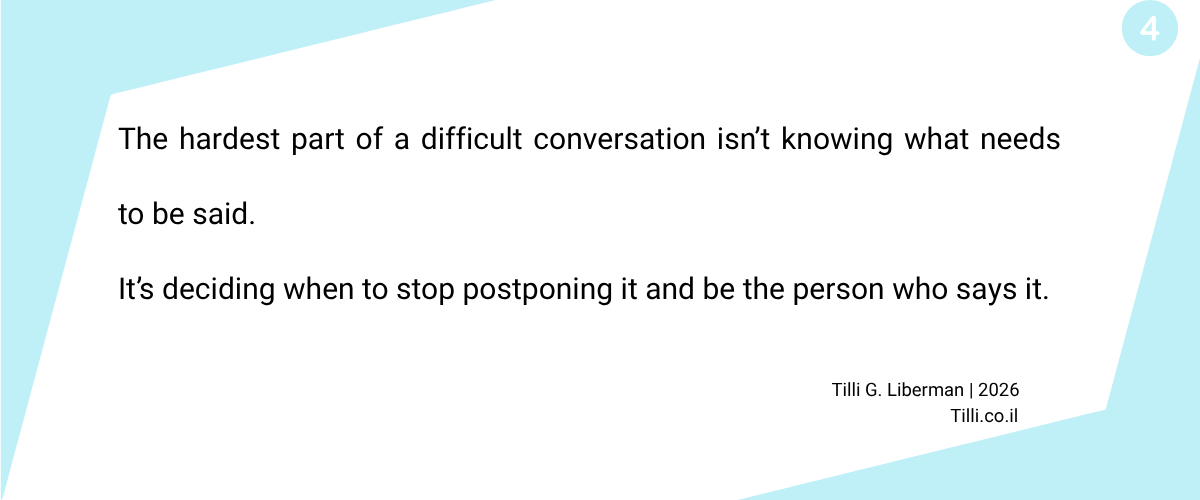
Because when these conversations feel uncomfortable, it is very easy to postpone them.
Until the next 1:1.
Until the formal feedback conversation.
Even until the mid year or annual review.
And by then, something that could have been a small course correction may have become a much bigger feedback conversation.
We tend to think about the risk of saying something difficult.
But postponing it has consequences too.
Someone may continue without information that could help them. A small gap can become harder to change. And we may miss an opportunity to help someone grow while there is still plenty of room to work with what is happening.
Being supportive and saying something difficult aren’t necessarily opposites.
Saying something while there is still room to work with it can be part of the support.
So alongside “Who am I to say this?” there is another question worth asking: What is my responsibility as a manager not to leave unsaid?
If there is a conversation you have been thinking about, postponing, or struggling to start, I created a new Moment that can help you explore what may be making it difficult and find a few more ways to approach it.
